


Crystal Ball
The consensus prediction of the TrueHoop Network bloggers…and the best hopes of By The Horns.
Crowd Says: 43-39
By The Horns Says: 46-36
Yes We Can!
The sun is out. The seas have parted. The basketball gods are shining upon us!
During the offseason, the Bulls lost free agent Ben Gordon, whom many people considered the team’s best or second-best player (after Derrick Rose). Memo to Chicago fans: Don’t sweat it. Seriously. Gordon will be replaced by John Salmons, who not only gave the Bulls almost as many points per game (18.3 versus 20.7) but was slightly more efficient in how he scored them (Salmons had a True Shooting Percentage of .596 and an Offensive Rating of 117 compared to Gordon’s .573 and 112). Even better, Salmons has the size (6-foot-7) and ability to defend opposing shooting guards … something Gordon couldn’t do unless he was exposed to Cosmic Rays or bitten by a radioactive spider.
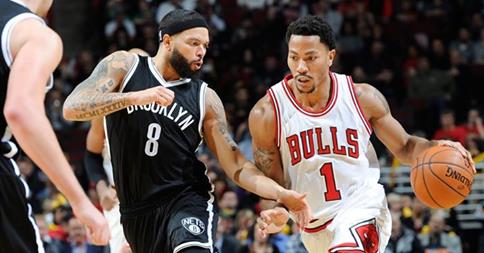
And that’s not the only good news. Derrick Rose spent the summer working on his jump shot (500 or more jumpers a day!) and seems poised to blossom into an All-Star. Kirk Hinrich (who could start for several teams) and Jannero Pargo (a fearless and streaky shooting assassin) might be the best backup backcourt combo in the league. Luol Deng should be healthy (I hope) and ready to party like it’s 2006-07 (when he had a career-high Player Efficiency Rating of 18.7). It’s a contract year for Tyrus Thomas, which means he’s likely to blow up. Joakim Noah would dive face-first into a swarm of man-eating sharks to win a basketball game, so expect him to be a rebounding, shot-blocking beast. Like Hinrich, Brad Miller is a starting-caliber player who proved last season he can be very effective in a reserve role. Rookies James Johnson and Taj Gibson have the raw talent necessary to provide support in short bursts off the bench. Lindsey Hunter is a first-rate (and mostly non-playing) locker room leader, and Aaron Gray hands out a mean cup of Gatorade.
To sum up, the Bulls have height and depth across the board. They have guys who can get to the rim (Rose and Salmons), guys who can shoot the ball (Deng, Hinrich, Pargo and Salmons), guys who can clean the glass (Miller, Noah and Thomas), and guys who can swat some shots (Gibson, Noah and Thomas). They still don’t have a low post scoring threat, which is a problem (maybe even a big problem), but they don’t have a gaping hole at any position. The Bulls won’t win the East (thanks to the Cavaliers, Celtics and Magic) or even the Central Division (because of the Cavs), but they’re going to be much better than the naysayers are predicting.
No You Won’t
A rousing dissent from a rival blogger.
From Mike Kurylo of Knickerblogger.net:
Quiz time, which Bull am I describing: “Athletic … good wingspan … more of a tweener … inconsistent scoring … has stretches where he disappears completely … questionable free throw shooter.”
A. Joakim Noah
B. Tyrus Thomas
C. James Johnson
D. Taj Gibson
E. All of the above
The answer is E, and therein lies the problems with the Chicago Bulls: they have too many forwards that are of a similar mold. Chicago needed to add someone to complement their young frontcourt of Noah and Thomas, but didn’t.
There are two ways to win in the NBA. The first is to be unbelievable good at a few major aspects of the game. The other way is to be well-rounded with enough weapons to counter any possibility. The Bulls are neither of these and hence were a middle of the pack team offensively and defensively last year. Until Chicago makes a commitment to address their weaknesses or bolster their strengths they’ll stay a tweener team.
All-A-Twitter
A 140-character insight into the soul of the team.
“In the play of the series, Joakim Noah steals the ball, beats Pierce down the court and dunks ‘and 1′ to put the Bulls up 126-123 35.5 to go.” — The official Chicago Bulls Twitter, commemorating what might be the greatest post-Jordan playoff moment from Game 6 of the Bulls’ first-round series against the defending champion Boston Celtics.
On The Record
Single best quote concerning the team during the last 12 months.
On January 30th, 2009, Bulls chairman Jerry Reinsdorf said: “This [season] has been a disaster. It’s embarrassing.” At that time, the Bulls were 19-27. After that tongue-lashing, the team acquired John Salmons and Brad Miller, finished 41-41, made the playoffs and pushed the defending champions to seven games in the first round.
The 2008-09 Almanac
Some key stats from last season.
Offense: 15th
Defense: 18th
Pace: 10th
Team Factor Strength(s): Offensive Rebounding (6th)
Team Factor Weakness(es): Defensive Rebounding (28th)
So offensively and defensively, the Bulls were strictly — maybe even painfully — mediocre. That’s bad. Furthermore, they were one of the worst defensive rebounding teams in the Association. That’s really bad. On the bright side, they cleaned up on the offensive glass — in fact, Noah ranked 2nd in the NBA in Offensive Rebounds Per 48 Minutes — so they have that going for them. Starting Salmons at SG and a healthy Deng at SF should help the team on offense and defense. And if Noah and Thomas can crash the defensive boards with a manic passion, the Bulls could become a real force in the East. Maybe not a championship-level force … but at least the kind of squad that other teams see on the schedule and say, “Oh, crap. The Bulls.”
The Play
Down a single point with 9.2 seconds to play in a must-win game. What’s the play?
For the last few seasons, the Bulls’ money play (and I use the word “play” loosely) has been Ben Gordon chucking it up from long range either off a screen or in isolation. And yeah, Gordon certainly gave us some lasting memories that way … but words can’t express how happy I am that we’ll never see that play again.
This season, I see Vinny Del Negro calling a high pick and roll with Derrick Rose and Brad Miller, where the first option is Rose driving to the hoop for a bucket or the foul; the second option is Rose pulling up for a short chip shot or floater; and the third option is a kick-out to Miller for a midrange jumper.
The People’s Choice
The fan favorite the crowd will be chanting for to see some action.
Aaron Gray has all the characteristics necessary to become a Brian Scalabrine-like folk hero in Chicago: he’s big, white, a little goofy-looking, and tries really, really hard. If the Bulls find themselves in the midst of a blowout, look for the United Center crowd to try and will Gray into the game. You know, once he recovers from that stress fracture in his left fibula.
If You’re Watching The Bottom Line, You’re Watching This
The single biggest spreadsheet issue hanging over the team.
The Bulls enter the 2009-10 season with approximately $25 million worth of expiring contracts, the largest of which is Brad Miller’s $12.2 million cap killer. Those expiring deals will almost certainly lead to one of two things: a blockbuster before-the-deadline trade or a major signing in the fabled Summer of 2010. That’s when LeBron James, Dwyane Wade, Chris Bosh, Amar’e Stoudemire, Carlos Boozer, Dirk Nowitzki and Joe Johnson (among others) become free agents. It’s no secret that the Bulls would love to add a premier frontcourt scorer … and there may never be a better chance for them to do it.
Yesterday’s post about Derrick Rose’s assists got me thinking about where the Bulls were shooting the ball from last season. Fortunately, 82games.com provides a Sortable NBA Team Shooting Stats page. I’ve used their data to create my own tables so that I can highlight the Bulls’ league rank and compare the team’s raw numbers to the league leaders.
82games.com stats legend
Att = Percentage of team’s shots from that range
Ast = Percentage of shot attempts that were assisted
Pts = Points per game
And1 = Opportunities, not conversions
Three-pointers

Thoughts: The Bulls used the three-pointer efficiently…but not very often. Long distance shots weren’t a big part of the Chicago offense last season. And, unless John Salmons and Jannero Pargo co-impersonate Ben Gordon, the Bulls will probably see an all-around drop in threes this season, particularly in terms of shooting percentage. Question: When a team doesn’t spread the floor, how does that affect their ability to score at the basket?
Two-pointers

Thoughts: The Bulls were strictly average in terms of shooting two-pointers. That’s pretty bad news considering the fact that the two-point shot was the primary component of the Chicago offense. But what do you expect from a drive-and-kick scoring system that lacks inside scoring? Unless Vinny Del Negro has expanded his playbook or management pulls the trigger on an in-season trade, these numbers aren’t likely to change much and the Bulls will remain a jump shooting team.
Inside shots

Thoughts: Only five teams had their inside shots blocked at a higher rate than the Bulls. Maybe that explains their (relatively) dreadful inside shooting percentage. Well, that and the fact that their bigs have trouble finishing around the basket. Of course, as I mentioned, the Bulls didn’t shoot many threes, which meant that opposing teams could clog the paint and focus on protecting the rim. At any rate, the Bulls desperately need to improve in this area if they want to improve as a team. Good thing Tyrus has been practicing the 15-17 foot jumper…
Miscellaneous shots

Thoughts: More middle-of-the-pack numbers…except for And1s. I never would have guessed the Bulls were almost in the top ten in that area. And here’s a bad omen for you: Ben Gordon led the team with 38 of those And1s. Derrick Rose was second with 35. Tyrus and Joakim had 22 each.
In my scouting report on Derrick Rose, I noted that the Bulls’ rookie point guard ranked 12th in the NBA in total assists (512) last season. Just for fun, here’s a list (in descending order) of the players who dropped more dimes than D-Rose: Chris Paul, Deron Williams, Steve Nash, Jason Kidd, Rajon Rondo, Jose Calderon, Dwyane Wade, LeBron James, Chris Duhon, Raymond Felton and Andre Miller. Immediately trailing Derrick were guys like Baron Davis, Tony Parker, Chauncey Billups, Devin Harris and Joe Johnson. All in all, Rose is keeping some pretty good company.
Here’s a breakdown of where those passes went:
Three-pointers: 136. NBA rank: 18th. For perspective, LeBron James led the league in three-point assists with 232. For a little added perspective, the Bulls were 23rd in the league in three-point attempts (1293) and 22nd in conversions (493). In the final tally, Rose assisted on close to 30 percent of the team’s made three-pointers. Those are reasonably solid numbers for a PG on a team that doesn’t chuck up a lot of long-range shots.
Two-point jumpers: 216. NBA rank: 5th. Only four players assisted on more two-point jump shots than Derrick. Those players were: Jason Kidd (307), Chris Paul (293), Jose Calderon (267) and Deron Williams (266). You can see that Rose is in elite company in this area. However, Derrick’s greatest strength as a passer sort of draws attention to his greatest weakness: Many of his dimes occur as a result of basic drive-and-kick plays. This is in part due to Vinny Del Negro’s rather primitive offensive schemes, but also because of Rose’s general lack of court vision and creativity. I don’t know what we can do about Vinny, but hopefully Derrick will mature as a playmaker this season and therefore improve in the following two catagories.
Close: 105. NBA rank: 29th. I really hate the fact that Rose generated so few in-close, high-percentage shots for his teammates. In this category, he even trailed Tim Duncan, a center. Obviously, it would help if Derrick had a big man who loved to finish at the rim. (Stop taking so many jumpers, Tyrus!) But still, a point guard’s responsibility is to get his teammates the best shots possible. That’s what Steve Nash did. He lead the league by helping his teammates convert 248 close shots.
Dunks: 55. NBA rank: 30th. Another depressingly low number for an elite point guard. Chris Paul, the floor leader against whom every PG is measured, led the league by assisting on 163 dunks…almost three times as many as Rose.
Passing Rating: According to 82games.com, Rose has a Passing Rating of 9.1 (NBA Rank: 27th). The Passing Rating was invented by the 82games staff to “reward passes leading to successful shots from close range at a higher rate than assisted outside shots, while including the rate of passing turnovers.” Basically, it’s about the passer giving the shooter the best percentage chance to convert a field goal.
Chris Paul led the league with a Passing Rating of 20.9. Meanwhile, Derrick trailed even guys like Golden State’s Stephen Jackson (9.8). At this point, Rose’s evolution as a player — and the Bulls’ evolution as a team — seriously depends on his ability to start creating easier offense for everybody on the roster…epecially without Ben Gordon as a bailout option.

The 2009-10 Bulls can't let guys like this own the paint.
The Bulls faced a recurring problem over the course of the 2008-09 season: They could not contain opposing big men. Even the bad ones. Stiffs (or at least non-premier bigs) like Anderson Varejao, Ben Wallace, Darko Milicic, Joel Przybilla, Nick Collison, Troy Murphy and Zaza Pachulia all enjoyed big games and/or season highs against the Chicago interior defense. That’s not good.
The always amazing 82games.com published NBA Team by Position Stats as well as NBA Team by Position Ranks. These pages provide all sorts of interesting little tidbits, such as the fact that the Bulls ranked 29th in scoring defense at the center position. Only the defenseless Golden State Warriors allowed opposing centers to score more points per game. Furthermore, the Bulls ranked 24th in scoring defense at the power forward position. They also ranked 23rd (at center) and 28th (at power forward) in defensive rebounding. So over the course of the season, Bulls opponents got about 40 PPG and 25 RPG out of their C and PF combos. Yikes.
If you peruse the various stats and ranks provided, you’ll notice that the Chicago front court was consistently outperformed last season. This is best evidenced by the Player Efficiency Rating (PER) averages. In case you’re not familiar with PER, it’s John Hollinger’s all-in-one basketball rating, which combines all of a player’s statistical contributions into a single number. It’s not a final evaluation of a player’s worth, but it does provide a snapshot of a player’s measurable contributions.
Anyway, PER-wise, the Bulls consistently outperformed their opponents at the point guard, shooting guard and small forward positions. However, the Bulls averaged PERs of 17.0 at power forward and 17.8 at center…while giving up PERs of 19.2 and 20.2. That equates to net losses at those positions of -2.2 and -2.3.
For a little additional perspective, the PER reference guide rates a 20 as a “Borderline All-Star.” This means that opposing power forwards and centers were playing at a borderline All-Star level against the Bulls…on average. Ironically, the Bulls’ best PER differential was at shooting guard, where they were +2.6 (which was good for the 7th best PER differential at that position in the league). So maybe the team’s defensive woes weren’t all Ben Gordon’s fault after all.